

Being Scared And Not Worried
Stepping out of our comfort zone
Being scared and not worried… The difference is subtle but big. Sometimes excitement feels like fear. We know when we are stepping out of our comfort zone. Maybe if we were honest with ourselves, we can even admit what we are looking forward to.
If we could take our eyes off the fear, they may land on what we long for. Maybe our wildest dreams are sitting behind a veil of fear, counting sheep, until we wake up. Maybe we have misinterpreted excitement as fear. Maybe it was always life calling us. And it kept leaving messages…
When we slow down enough to feel into the sensation we call fear, we often discover it is not as solid or threatening as it first appeared. Fear tends to tighten and constrict, while excitement carries movement and energy.
The body often knows the difference before the mind does. A quickened heartbeat, a rush of sensation, a heightened awareness—these can belong to either, depending on how we interpret them.
Being scared does not always mean something is wrong. Sometimes it simply means something new is asking to be lived.
Not worried means we are not projecting into imagined outcomes or rehearsing failure ahead of time.
It means we are present with the moment, aware of the edge we are standing on, yet not consumed by stories of what might go wrong. In this space, courage is quiet and grounded, not loud or forceful.
Worry pulls us away from the present and into mental loops. It asks us to solve problems that have not yet arrived. Fear, when unaccompanied by worry, can actually sharpen clarity. It can wake us up. It can signal that we are about to cross an internal threshold, one that stretches our sense of identity and possibility.
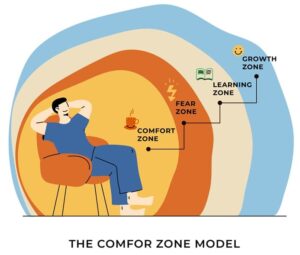
Growth often begins at the edge of comfort, where fear and excitement meet.
Often what we call fear is the moment just before expansion. Growth rarely feels comfortable.
It asks us to loosen familiar definitions of ourselves and trust what we have not yet mastered. The longing beneath fear is usually very honest—it points toward aliveness, creativity, love, or truth that wants expression.
When we allow ourselves to notice what we are drawn toward, fear loses some of its authority.
Listening to these inner signals requires gentleness. We do not need to push ourselves off cliffs or force bravery.
Sometimes simply acknowledging, “I am scared, but I am not worried,” is enough to create space.
In that space, discernment replaces avoidance. We can choose our steps consciously rather than retreat automatically.
Life’s invitations are rarely loud. They whisper through sensations, intuition, and subtle excitement. When we stop labeling every unfamiliar feeling as danger, we may realize we have been receiving messages all along—messages pointing us toward fuller participation in our own lives.
In this way, fear becomes less of an obstacle and more of a doorway. Not something to eliminate, but something to listen to. When worry falls away, what remains is awareness, curiosity, and the quiet courage to answer life when it calls.