

Know Who You Are And Own It
Self-Acceptance, Authenticity, and Purpose
“Know who you are and own it!” is your powerful call to self-acceptance, authenticity, and purpose, urging you to strive to understand your core values, strengths, and uniqueness, by living confidently in those truths, rather than conforming to external pressures.
“Know who you are and own it” is more than a motivational phrase. It asks you to understand yourself at a deep level and to stand firmly in that understanding, even when it challenges social norms, family conditioning, or old self-doubt.
This kind of self-knowing is not about ego or self-promotion; it is about alignment—living in a way that feels honest, coherent, and whole.
When you truly know who you are, life becomes less conflicted. Decisions feel clearer, relationships feel more authentic, and energy is no longer wasted trying to be someone else.
Owning who you are means recognizing your values, your sensitivities, your strengths, and even your flaws—and understanding that all of these belong.
From this place, purpose naturally emerges. When a person begins to serve what feels true to them, life often reorganizes itself around that service, creating a sense of meaning and flow.
What ‘Know Who You Are And Own It’ Means
Self-Knowledge
Self-knowledge begins with understanding what genuinely matters to you. This includes recognizing your values, emotional needs, desires, boundaries, and the activities or ideas that make you feel most alive. It requires honesty about what drains you as well as what energizes you. Knowing yourself in this way provides a stable inner reference point, allowing you to navigate life with greater clarity and intention.
Authenticity
Authenticity means acting in alignment with your inner truth rather than adjusting yourself to meet external expectations. It is the practice of expressing what feels real to you—your opinions, emotions, and values—even when doing so feels uncomfortable. Authenticity does not require perfection; it requires presence and courage. Over time, living authentically builds trust with yourself and creates relationships rooted in truth rather than performance.
Empowerment
Empowerment arises when you value your own perspective and purpose. It is the confidence that comes from knowing your gifts and using them intentionally, rather than seeking constant validation from others. Empowered individuals are more resilient because their sense of worth is internally grounded. They recognize that their contribution matters, even if it looks different from what society rewards or celebrates.
Ownership
Ownership is the willingness to accept your differences, imperfections, and life experiences without shame. It means understanding that your unique path—including struggles, sensitivities, and mistakes—has shaped strengths that belong only to you. When you own your story rather than resist it, those differences become sources of wisdom and depth instead of self-judgment.
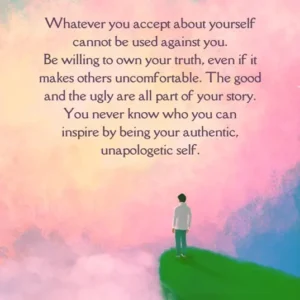
A visual reminder that self-acceptance and authenticity are the foundation of personal empowerment
How To Own Your Truth
Self-Reflection
Self-reflection involves asking honest questions about who you are and how you became that way. This includes examining formative experiences, recurring patterns, strengths, fears, and blind spots. Reflection is not about criticism; it is about awareness. By understanding your inner landscape, you gain the ability to respond consciously rather than react automatically.
Seek Feedback
Trusted friends, partners, or mentors can often see qualities in us that we overlook. Asking others how they experience you—what strengths they notice, how you show up under stress, what feels authentic about you—can provide valuable insight. Feedback works best when received with curiosity rather than defensiveness, serving as another mirror for self-understanding.
Mindfulness and Therapy
Practices such as meditation, mindfulness, or therapeutic work help create space between awareness and emotion. This distance allows you to observe thoughts and feelings without being consumed by them. Over time, these tools support clarity, emotional regulation, and a deeper understanding of your internal motivations and patterns.
Embrace Uniqueness
Embracing who you are means allowing your depth, sensitivity, spirituality, creativity, or unconventional perspectives to exist without apology. Many people suppress these qualities to fit in, but doing so often leads to exhaustion and disconnection. Accepting your uniqueness restores energy and allows you to live more freely and honestly.
Why Owning Who You Are Matters (The Benefits Of Knowing Yourself)
Happiness and Vitality
Living in alignment with your true self brings a sense of vitality that cannot be manufactured. When you stop resisting who you are, energy once spent on self-correction becomes available for creativity, joy, and engagement with life. Happiness becomes less about circumstance and more about inner congruence.
Better Decisions
Knowing yourself provides a clear internal compass. Choices become easier because they are guided by values rather than confusion or external pressure. This clarity reduces regret and builds trust in your own judgment over time.
Resilience
A strong sense of self makes you less vulnerable to comparison, criticism, or social pressure. When challenges arise, resilience comes from knowing who you are beneath circumstances. This groundedness allows you to adapt without losing yourself.
Connection
True self-acceptance creates space for genuine connection with others. When you are comfortable with your own humanity, you are more open, empathetic, and present. Relationships deepen because they are based on authenticity rather than roles or expectations.
Living Authentically By Owing Your Truth
Owning who you are and living confidently in your truth
Knowing who you REALLY are leads to greater happiness, better decisions, and less inner conflict, instilling empowerment and wisdom. It’s about recognizing your authentic self—deep feelings, unique perspectives, even flaws—and embracing all of it as beautiful and valuable.
There is a crucial need for self-awareness and inner definition, and without it, external societal pressures and other people’s judgments will impose an identity upon you, leading you to live a life not truly your own.
Knowing who you are and owning it is a call for individuation, urging people to discover their core values and purpose, rather than passively accepting roles others assign, thereby preventing a fragile self-image and promoting authenticity.
Discovering one’s purpose and then serving it, changes a person. Life organizes itself around those who serve their purpose. Knowing who you are and owning it is not a one-time realization, but an ongoing relationship with yourself.
It asks for honesty, patience, and the courage to live from inner truth rather than external expectation. When you define yourself from the inside out, life becomes less about proving and more about being.
From that place of self-acceptance, purpose clarifies, choices align, and a quiet confidence emerges—one rooted not in approval, but in authenticity.