Shared Dreaming and Mutual Dreams
Parallel, Telepathic, and Psychic Dream Experiences
A shared dream is an experience in which two or more people report the same dream, a similar dreamscape, or connected dream events occurring at the same time. Often called mutual dreaming, parallel dreaming, dream meshing, dream linking, or simply shared dreaming, these experiences suggest that dreaming may not always be a private, isolated act of the mind, but can sometimes feel relational, resonant, or meaningfully connected between people.
Some people view shared dreams as psychological coincidence, while others experience them as psychic, telepathic, or spiritually meaningful encounters that point to consciousness operating beyond the individual self.
Throughout history and across cultures, individuals have shared dreams as a way of understanding emotions, strengthening bonds, and making sense of shared experiences.
Shared dreaming is a fascinating phenomena to study, often occurring between emotionally or physically close individuals, that involve interconnected dreams with shared themes, characters, or events within the dream.
How Does Shared Dreaming Happen?
The nature of shared, parallel, and mutual dreams
Shared dreaming (or mutual dreaming) happens when two or more people experience the same dream or a very similar dream simultaneously, meeting within a shared dream landscape, which can range from having common themes to experiencing identical scenarios, often seen as a deep emotional or Spiritual connection as evidence and psychological theories (like Carl Jung’s collective unconscious) suggests.
In some cases, people report dreams that seem to overlap in theme, symbolism, or emotional content, giving rise to the concept of mutual dreaming. Rather than suggesting control or intrusion, dream sharing emphasizes communication, reflection, and connection, inviting a deeper look at how dreams can mirror relationships, collective states of mind, and shared inner worlds.
Common Patterns In Mutual Dreaming Experiences
Are shared dreams real?
Mutual dreaming is often discussed in relation to the idea of a collective unconscious—a shared psychological layer proposed by Carl Jung that contains universal symbols, themes, and emotional patterns. While mutual dreams do not “prove” this concept in a scientific sense, they do offer compelling experiential examples of how different minds can draw from similar symbolic material, especially when people are emotionally connected or facing shared life circumstances.
In some reports of mutual dreaming, individuals describe being present in what feels like the same dream environment, observing similar scenes, or encountering parallel events. These experiences are usually recognized after the fact, when dream details are compared and striking similarities emerge. Rather than literal co-location, this may reflect synchronized inner processing shaped by shared emotional or relational dynamics.
Mutual dreams often share common themes, settings, symbols, or emotional atmospheres—even when the narratives differ. Research into dream comparison has shown that people with strong emotional bonds can report unusually high similarity ratings in dream imagery and feeling states. This suggests that emotional attunement and shared psychological material may influence how dreams are formed and remembered.
These types of dreams most frequently occur between partners, close friends, family members, or individuals navigating an intense shared experience. Mutual dreaming may arise during periods of emotional transition, stress, grief, or deep connection, reflecting an unconscious need for understanding, reassurance, or relational integration rather than a deliberate or controlled process.
Mutual dreaming does not appear in a single, fixed form. Experiences range from nearly identical dreams to loosely parallel dreams that contain matching symbols, themes, or emotional currents. In many cases, the connection becomes clear only through discussion and reflection, emphasizing that mutual dreaming is often subtle, interpretive, and deeply personal rather than dramatic or overt.
How Shared Dreams Are Commonly Experienced
Shared dream experiences are most often recognized after dreams are discussed and compared. Rather than feeling identical or scripted, these dreams tend to reveal meaningful overlaps in imagery, emotion, or focus. The following points describe common ways people notice and make sense of shared or mutual dreaming.
Dream telepathy between lovers is most often described as an intuitive or emotional resonance that appears in dreams rather than a deliberate exchange of information. Partners may dream about one another simultaneously, share similar dream themes, or experience emotionally synchronized dreams during periods of closeness, stress, or transition. These experiences are usually understood as reflections of deep emotional attunement, shared concerns, or unconscious empathy rather than literal mind-to-mind communication.
Shared dreams with a partner often reveal overlapping symbols, settings, or emotional tones that mirror the relationship itself. Couples may discover these similarities after discussing their dreams, realizing that both were processing the same issues—such as trust, distance, or future decisions—through dream imagery. These shared elements suggest a mutual psychological or emotional landscape shaped by daily life, intimacy, and unresolved conversations.
The shared dreams spiritual meaning is commonly interpreted as a sign of connection, alignment, or shared growth rather than proof of supernatural ability. In spiritual traditions, such dreams are seen as invitations to reflect on unity, compassion, or collective purpose. Whether approached spiritually or psychologically, shared dreams often point to an underlying relational or emotional truth seeking conscious awareness.
When people ask what is dream sharing examples, they are usually referring to situations where two or more individuals report dreams with striking similarities after open discussion. Examples include friends dreaming of the same location, family members sharing symbolic imagery during times of grief, or partners experiencing parallel dream narratives. These examples highlight how shared environments, emotions, and relationships influence dream content.
From a psychological perspective, what is dream sharing psychology focuses on how emotional bonds, empathy, and shared experiences shape unconscious imagery. Dream sharing is often explained through concepts such as emotional contagion, attachment theory, and the collective unconscious. Rather than suggesting intrusion into another’s mind, psychology views dream sharing as a natural outcome of interconnected inner lives.
Taken together, these experiences suggest that dream sharing operates along a continuum rather than as a single phenomenon. Whether expressed as emotional resonance between partners, shared symbolic themes, or spiritually meaningful parallels, these dreams appear to arise from deep relational attunement and shared inner processing.
Psychological insight, personal experience, and spiritual interpretation all point to the same core truth: dreams do not form in isolation. They are shaped by connection, empathy, memory, and meaning—sometimes aligning closely enough between people to feel shared.
Understanding this broader landscape helps create a clear foundation for exploring the more complex and debated questions surrounding how consciousness, relationship, and dreaming may intersect.
Dream Telepathy – What Are Telepathic Dreams?
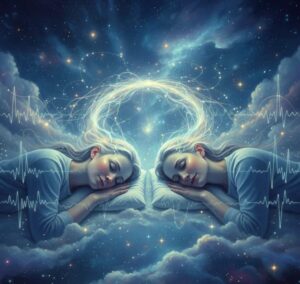
A symbolic moment of telepathic shared dreaming, reflecting the deep psychic bond between two connected souls.
Shared Dreaming Telepathically: Two Minds Connecting Beyond Sleep
Dream telepathy is communicating telepathically during your dreams and sharing night or daydreams with others.
Sharing dreams telepathically refers to the experience of perceiving, influencing, or emotionally connecting with another person through dreams.
Rather than being a deliberate act, telepathic dreams are sometimes reported as spontaneous and meaningful, occurring between people who share a close emotional bond such as twins, for example.
These experiences sit at the crossroads of psychology, parapsychology, and lived experience, and are often recognized only after dreams are shared and compared.
Dream Telepathy And Psychic Ability
Dream telepathy is also a psychic ability (sometimes called Nocturnal ESP) that can perceive, influence, or communicate telepathically within another person’s dreams.
Dream telepathy is a psychic phenomenon in which information, emotion, imagery, or awareness is exchanged between individuals through the dream state.
In telepathic dreams, the dreaming mind becomes receptive to signals beyond ordinary sensory perception, allowing two people to connect psychically while asleep or in altered dream states.
These experiences are often reported between lovers, family members, close friends, or spiritually bonded individuals, where energetic and emotional links are already strong.
Many psychics describe dream telepathy as a form of Nocturnal ESP, where the subconscious mind is freed from physical limitations and can access telepathic channels more easily.
Telepathic dreams may involve shared scenes, direct communication, symbolic messages, or the sensation of another person’s presence within the dream. Unlike ordinary dreams, these experiences often feel unusually vivid, intentional, and emotionally charged, leaving a strong impression upon waking.
Telepathic dreams are a fascinating phenomena with research that continues to explore the deep connections of our shared and mutual dreaming minds.
Related Psychic Concepts in Telepathic Dreams
Lucid Dreaming (Psychic Awareness Within the Dream State)
Lucid dreaming allows the dreamer to become conscious within the dream, making it a powerful gateway for psychic experiences. Many psychic practitioners believe lucidity enhances telepathic ability, as awareness within the dream allows intentional communication, observation, or reception of psychic information. Lucid dreamers may consciously seek contact with another person, receive messages, or recognize that a dream interaction carries telepathic significance.
Projective Identification (Psychic Projection Through Dreams)
Within a psychic framework, projective identification can be understood as the unconscious projection of thoughts, emotions, or energetic impressions into another person’s dream space. Strong emotional bonds, unresolved issues, or psychic sensitivity can cause one person’s inner material to appear symbolically or directly in another’s dreams. In psychic practice, this is sometimes viewed as unintentional dream projection rather than deliberate astral travel.
Parallel Dreaming – What Are Parallel Dreams And What Do They Mean?
Dreaming in a Parallel Universe
Parallel dreams sometimes act as portals to alternate realities, connecting a person to another version of themselves in a parallel world.
Parallel dreaming refers to the concept explored in Spiritual Dreamwork and Noetic Science, that dreams are experiences or glimpses into parallel universes, alternate timelines, or different versions of ourselves, allowing us to see lives we might have lived or realities where different choices were made, acting as portals to other dimensions.
Experiencing Parallel dreams suggest that dreams aren’t just about random brain activity but genuine experiences of other coexisting realities, where we might encounter alternate selves or learn from different life paths.
Parallel Dreaming and Multidimensional Consciousness:
Parallel Dreams offer experiences in other worlds or timelines not our own, aligning with multiverse theories where infinite realities exist. In parallel dreaming, these experiences may feel immersive and internally consistent, as if the dreamer is temporarily observing or participating in a reality that follows its own logic. Many psychics believe these dreams are not random fantasy, but glimpses into alternate planes, timelines, or dimensions that coexist alongside our own.
You might experience life as a version of yourself who made different career or life choices, giving insight into “what if” scenarios. Parallel dreams can feel deeply personal and emotionally charged, often highlighting paths not taken or potentials left unexplored. From a psychic perspective, alternate-self dreams may allow awareness to momentarily align with parallel expressions of the soul, offering insight, closure, or guidance for current-life decisions.
During sleep, consciousness may detach from physical constraints, allowing it to “travel” or perceive these other realities, a concept sometimes linked to quantum physics. In this view, the dreaming state acts as a gateway where awareness is no longer anchored to linear time or physical identity. Many believe parallel dreaming reflects the mind’s ability to move beyond ordinary perception, accessing layers of reality normally filtered out during waking consciousness.
Parallel dreams can serve as a way for different versions of your consciousness to learn from each other, processing experiences and integrating new perspectives. Rather than being purely observational, these dreams may function as an exchange of insight, where lessons, emotions, or understandings from alternate experiences subtly influence waking awareness. This process is often described as intuitive learning rather than intellectual memory.
Some believe déjà vu or sudden insights come from these connections, a bleed-through of information from parallel lives, past lives, or past timelines. Moments of familiarity, sudden creative breakthroughs, or an unexplainable sense of recognition may be interpreted as echoes from parallel dreaming experiences. In psychic traditions, these sensations are seen as reminders that consciousness is layered, interconnected, and not limited to a single timeline or identity.
Dreaming Across Timelines and Realities
Parallel dreaming invites a broader view of consciousness—one that extends beyond a single identity, lifetime, or linear timeline. Whether understood as symbolic, psychic, or multidimensional, these dreams often carry a sense of continuity and meaning that lingers after waking. By paying attention to their themes and emotional impact, parallel dreams can offer insight, inspiration, and a deeper understanding of how consciousness may move, learn, and remember beyond ordinary awareness.
10 FAQS About Dream Sharing And Mutual Dreaming
Yes, two people can be connected through dreams, especially when there is a strong emotional, energetic, or spiritual bond between them. From a psychic viewpoint, dreams create a receptive state where intuitive and telepathic connections are more accessible, allowing shared imagery, emotions, or awareness to emerge naturally.
People may share the same dreams because their subconscious minds are attuned to similar emotional states, intentions, or psychic frequencies. In psychic theory, shared dreams can occur when two individuals are energetically aligned, processing the same experience, or unconsciously communicating beyond waking awareness.
A double dream is often referred to as a mutual dream or shared dream, where two people independently experience dreams with overlapping symbols, settings, or narratives. In psychic contexts, this may also be described as a form of dream telepathy or synchronized dreaming.
Parallel dreams are dreams that are not identical but share strong similarities in theme, emotion, or symbolism. These dreams often occur between people who are closely connected and may indicate parallel psychic processing or shared energetic influences rather than direct interaction within the same dream space.
Yes, dream telepathy is considered possible within psychic and parapsychological traditions. Many believe the dreaming mind is more open to telepathic exchange, allowing thoughts, emotions, or imagery to be communicated between individuals without physical contact, particularly during sleep or altered states of consciousness.
Dream sharing works through subconscious and energetic connection rather than conscious intention. During sleep, the mind relaxes its boundaries, making it easier for shared symbols, emotions, or psychic impressions to arise between people who are emotionally or spiritually linked.
Yes, many people report connecting with others in their dreams, either symbolically or through direct interaction. In psychic terms, this connection may involve telepathic exchange, shared dream space, or energetic communication that feels distinctly different from ordinary dreaming.
Dream sharing is considered real within psychic, spiritual, and experiential frameworks. While it may not always involve identical dreams, recurring similarities and meaningful overlaps reported by individuals suggest that shared dreaming is more than coincidence for those who experience it.
To share dreams means that two or more people experience dreams with connected themes, symbols, emotions, or awareness. Psychically, this can indicate emotional intimacy, energetic resonance, or unconscious communication occurring through the dream state.
Dream telepathy is regarded as real by many psychics and spiritually sensitive individuals. It is believed to occur when the mind is freed from physical limitations during sleep, allowing intuitive and telepathic communication to take place through dreams rather than waking thought.
Dream sharing, telepathic dreaming, and parallel dreaming invite us to reconsider what happens when consciousness loosens its grip on the waking world. Whether understood as psychic connection, shared unconscious material, or travel across subtle realities, these experiences consistently point to one truth: the dreaming mind is not isolated.
Dreams appear to operate in a relational space, where emotions, intentions, memories, and awareness can overlap, resonate, and sometimes intersect with others.
By paying attention to these experiences with curiosity rather than fear or fantasy, we begin to recognize dreaming as an active field of communication and perception—one that has been explored by mystics, psychics, and dreamers across cultures and throughout history.
In this way, dreams are not just private stories of the mind, but living encounters with consciousness itself.